
Canadian guidelines on HIV pre- and postexposure prophylaxis: 2025 update
CTN+
This guideline updates the 2017 guideline on clinical indications and drug regimens for PrEP and PEP in Canada and contains 31 recommendations and 10 good practice statements.
Access This Resource
Led by Prevention & Testing Think Tank Co-lead Dr. Darrell Tan, this guideline updates the 2017 guideline on clinical indications and drug regimens for PrEP and PEP in Canada and contains 31 recommendations and 10 good practice statements.
AccessBackground
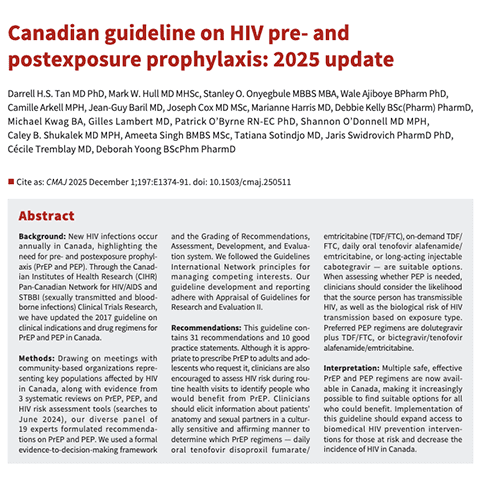
New HIV infections occur annually in Canada, highlighting the need for pre- and postexposure prophylaxis (PrEP and PEP). Through the Canadian Institutes of Health Research (CIHR) Pan-Canadian Network for HIV/AIDS and STBBI (sexually transmitted and blood-borne infections) Clinical Trials Research, we have updated the 2017 guideline on clinical indications and drug regimens for PrEP and PEP in Canada.
Methods
Drawing on meetings with community-based organizations representing key populations affected by HIV in Canada, along with evidence from 3 systematic reviews on PrEP, PEP, and HIV risk assessment tools (searches to June 2024), our diverse panel of 19 experts formulated recommendations on PrEP and PEP. We used a formal evidence-to-decision-making framework and the Grading of Recommendations, Assessment, Development, and Evaluation system. We followed the Guidelines International Network principles for managing competing interests. Our guideline development and reporting adhere with Appraisal of Guidelines for Research and Evaluation II.
Recommendations
This guideline contains 31 recommendations and 10 good practice statements. Although it is appropriate to prescribe PrEP to adults and adolescents who request it, clinicians are also encouraged to assess HIV risk during routine health visits to identify people who would benefit from PrEP. Clinicians should elicit information about patients’ anatomy and sexual partners in a culturally sensitive and affirming manner to determine which PrEP regimens — daily oral tenofovir disoproxil fumarate/emtricitabine (TDF/FTC), on-demand TDF/FTC, daily oral tenofovir alafenamide/emtricitabine, or long-acting injectable cabotegravir — are suitable options. When assessing whether PEP is needed, clinicians should consider the likelihood that the source person has transmissible HIV, as well as the biological risk of HIV transmission based on exposure type. Preferred PEP regimens are dolutegravir plus TDF/FTC, or bictegravir/tenofovir alafenamide/emtricitabine.
Interpretation
Multiple safe, effective PrEP and PEP regimens are now available in Canada, making it increasingly possible to find suitable options for all who could benefit. Implementation of this guideline should expand access to biomedical HIV prevention interventions for those at risk and decrease the incidence of HIV in Canada.